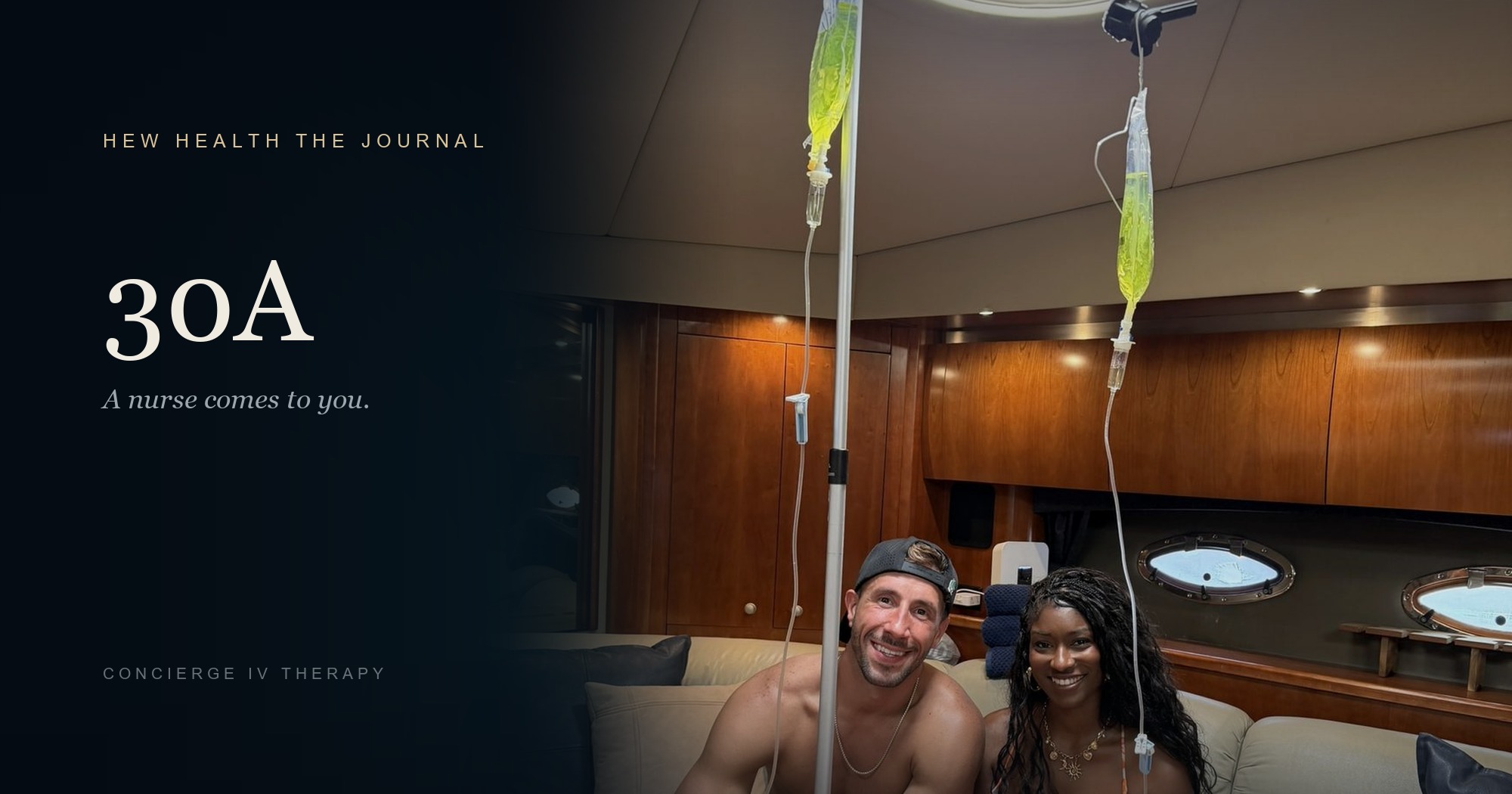
Anyone who has spent a July afternoon on the sand between Rosemary Beach and Grayton knows the particular flavor of exhaustion the Emerald Coast produces. It is not the same as being tired after a hike in the mountains or a long day in the city. The combination of heat index, salt air, reflected UV off white quartz sand, and a cocktail or two on an empty stomach adds up in a way most visitors (and plenty of locals) underestimate until they are lying on the couch at the rental with a throbbing head and no appetite for the dinner reservation.
At Hew Health we run a concierge mobile IV service along 30A and the surrounding Emerald Coast, and the pattern repeats every summer. This article walks through why electrolyte and fluid losses are genuinely different in this environment, what a bag of IV fluid can and cannot do for you, and how the home visit itself works when a nurse pulls into the driveway of your beach house or ties up alongside your boat.
Why 30A is harder on your hydration than you think
Three things stack here that you do not get in most places.
First, humidity. When the dew point sits in the mid-70s, sweat does not evaporate efficiently. Your body keeps producing it, trying to shed heat, but the cooling effect is muted. You can easily lose a liter or more of fluid per hour of active beach time without feeling especially sweaty, because the moisture is just sitting on your skin. Sodium, potassium, chloride, and magnesium leave with it.
Second, the sand itself. The sugar-white quartz along 30A reflects a significant fraction of incoming UV back up at you. Your face, the underside of your chin, and the backs of your legs catch a dose you would not get on darker sand. Sunburn is an inflammatory injury, and inflamed skin pulls fluid out of the vascular space into the tissues. That is part of why a bad burn makes you feel systemically awful the next morning, not just sore.
Third, the day usually includes alcohol. Frosé at lunch in Seaside, a few beers on the boat, wine with dinner in Alys. Alcohol is a diuretic and also blunts the hormonal signals (vasopressin, aldosterone) that normally help you hold on to water and sodium when you are losing both through sweat. You end up behind on fluids and behind on electrolytes at the same time.
Add a 6 a.m. flight into VPS, a paddleboard session, and two hours on a pontoon with no shade, and the math gets ugly quickly.
What electrolyte depletion actually feels like
In our practice we see a fairly consistent symptom cluster in patients who call from their rental after a long beach day:
- A dull frontal or temporal headache that does not respond well to ibuprofen
- Nausea and a strong aversion to the idea of food, even though they have barely eaten
- Muscle cramps in the calves or hands, sometimes in the abdomen
- Lightheadedness when standing up from the couch or bed
- Poor sleep the night before, followed by a flat, foggy feeling the next morning
- A heart rate that feels higher than it should at rest
None of this is mysterious. It is the predictable result of being down one to three liters of fluid with proportionate sodium losses, often compounded by a mild sunburn and residual alcohol metabolites. The body will usually sort itself out over 24 to 48 hours with oral fluids, salt, shade, and sleep. The question is whether you want to spend a full vacation day in that state.
What IV hydration actually does, honestly
An IV bag puts isotonic fluid and electrolytes directly into your vascular space. That is the entire mechanism. You skip the gut, which matters when you are nauseated and not drinking well, and you restore circulating volume within the time it takes the bag to run in, usually 30 to 60 minutes. Adding B vitamins, magnesium, or vitamin C repletes nutrients that may be low, particularly after heavy sweating or several days of poor eating.
IV hydration and vitamin therapy is wellness support, not treatment for a medical condition. It will not cure a hangover, it will not treat heat illness, and it will not prevent any disease. What it reliably does is correct the volume and electrolyte deficit faster than a bottle of Gatorade can, which is why people feel noticeably better by the time the nurse is packing up.
If you have true heat stroke (confusion, core temperature above 104, no sweating), that is an emergency room problem, not a mobile IV problem. Our nurses are trained to recognize the difference and will tell you so.
How the mobile visit works on 30A
A licensed registered nurse drives to wherever you are. That includes rental condos in Seacrest and Watersound, beach houses in WaterColor and Seagrove, hotel rooms in Miramar Beach and Destin, and private homes from 30A west through Fort Walton Beach and out to Navarre. In summer we also meet boats at the slip, and we come out to the Crab Island sandbar when the boat is anchored and shut down. We do not start an IV on a vessel that is under way.
Before anything is mixed, a Hew Health provider reviews the order for you specifically: what is in the bag, the dose of each additive, any interactions with medications you take, and whether IV therapy is appropriate for you at all that day. The nurse arrives with the pre-reviewed drip, checks your vitals, confirms your history, places the IV, and stays for the duration of the infusion.
There are people the nurse will decline on site. Anyone who is visibly intoxicated. Anyone pregnant without OB clearance. Anyone with a heart, kidney, or liver condition that has not been cleared by their physician. This is not a sales process, it is a clinical one, and the nurse has both the authority and the responsibility to say no when saying yes would not be safe.
When it makes sense to call
The patients who get the most out of a home IV visit on 30A tend to fall into a few groups. Families partway through a week-long rental who want one adult back on their feet so the vacation does not collapse. Wedding parties the morning after the welcome dinner. Boat days where everyone underestimated the sun. Athletes doing the Seaside Half or a long open-water swim. Travelers who flew in dehydrated and want to start the week ahead rather than behind.
It is reasonable to try oral rehydration first. Water, salt, a real meal, air conditioning, and a few hours of rest fix most mild cases. If you are past that point, or you know your body well enough to know you are not going to catch up orally in time for whatever you have planned tomorrow, a home visit is a practical option.
If you would like to talk through whether it is appropriate for your situation, see how concierge IV therapy works in 30A and call or text the number listed on that page. A member of our team can answer questions about what is in each drip, what the nurse will ask you on arrival, and how we handle visits to rentals, hotels, and boats across the Emerald Coast.
A few practical notes for your trip
Drink more water than feels necessary on travel days. Salt your food. Keep an eye on the smallest and the oldest people in your group, who dehydrate faster than healthy adults in their 30s and 40s. Reapply sunscreen every two hours on the sand, and more often on the boat. If someone in your party stops sweating, gets confused, or cannot keep fluids down, do not wait for a mobile service. Call 911 or go to the nearest ER.
The Emerald Coast is one of the best places in the country to spend a week. A little respect for the heat and the sun is what lets you enjoy it fully, and a concierge IV visit is one of several tools, not the first one, for the days when the math caught up with you.
Related from Hew Health