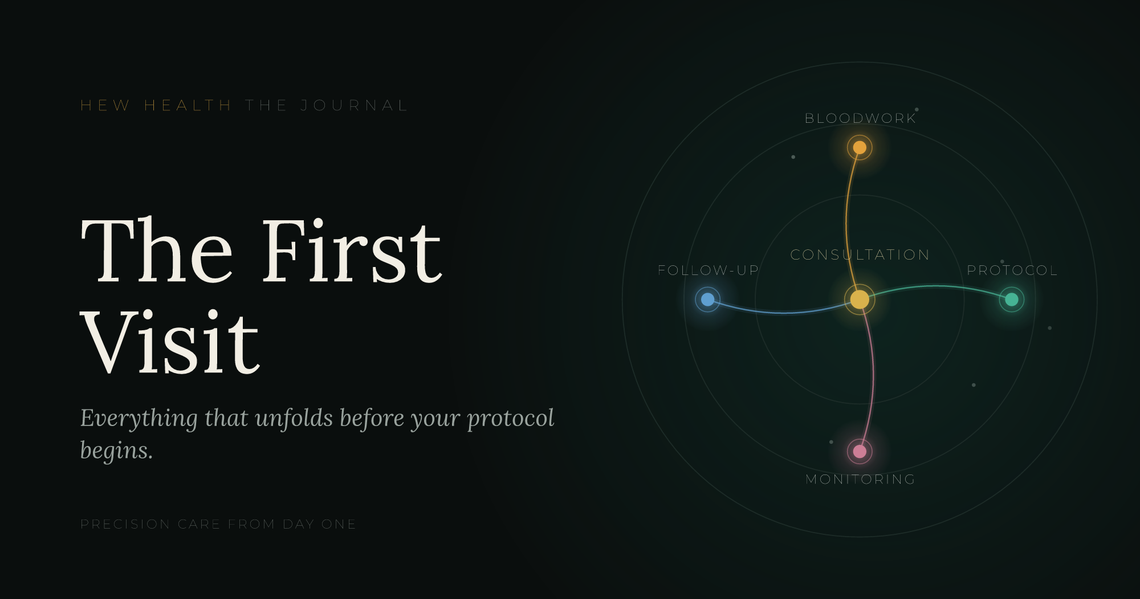
Most people arrive at our office having already done a lot of reading. They've tracked their sleep, noticed the weight that won't budge, felt their drive flatten, and been told by someone that their labs are "normal." If that sounds familiar, you're the reader I'm writing for. Here is what actually happens when you sit down with us for a hormone optimization consultation, from the paperwork before you arrive to the follow-up months later.
Before the First Visit
The consultation really begins a week or two before you walk in. We send a detailed intake that goes well beyond a typical new-patient form. We want your symptom timeline, your sleep patterns, your training history if you have one, prior labs going back as far as you can find them, every supplement and prescription you take, and a candid account of what you want to feel differently. Specifics matter. "Low energy" tells me little. "I used to lift four days a week and now I'm asleep on the couch by 8:30" tells me a great deal.
We also order comprehensive bloodwork ahead of time so we're not guessing in the room. For most adults considering hormone optimization, that panel includes a complete metabolic workup, a full lipid panel with ApoB, fasting insulin and HbA1c, a thyroid panel with free T3, free T4, reverse T3 and antibodies, a complete sex hormone profile (total and free testosterone, SHBG, estradiol measured by sensitive assay, DHEA-S, progesterone where appropriate), LH and FSH, PSA for men over 40, vitamin D, ferritin, B12, and high-sensitivity CRP. For women we time the draw to the cycle when that's clinically useful. This is the baseline. Without it, any conversation about optimization is speculation.
The Visit Itself
Plan on 60 to 90 minutes. There is no clipboard-wielding resident, no nurse popping in to say the doctor is running behind. In our practice, the physician who will manage your care is the one sitting across from you from the first minute to the last.
We spend the first stretch talking, not typing. I want to understand how you got here. Men in their mid-40s often describe a gradual erosion: workouts stopped producing results, recovery takes days instead of hours, mood is flatter than it used to be, morning erections have become rare. Women in perimenopause describe a different pattern, usually a sudden shift in sleep architecture, temperature regulation, cycle changes, mood volatility that feels foreign, and a sense that their body is operating on new rules nobody explained. These narratives shape how I read the labs.
Then we go through the bloodwork together, number by number, on a screen you can see. I'll explain what each marker means, where you sit relative to population ranges and relative to what we see in healthy adults of your age and training status. The two are not the same. A total testosterone of 380 ng/dL falls inside the lab's reference range. It is not where a 42-year-old man who wants to feel like himself again is going to thrive.
How We Think About a Protocol
If hormone optimization is appropriate, we discuss options in plain language. For men, that usually means a conversation about testosterone (injectable, cream, or pellet), the role of hCG or enclomiphene for men who want to preserve fertility or testicular function, and when an aromatase inhibitor is or is not warranted (usually not, in my experience, when dosing is thoughtful). For women, the conversation is broader and more individualized. We talk about estradiol delivery (patch, cream, pellet), micronized progesterone for women with a uterus and for its sleep and mood benefits, and whether low-dose testosterone makes sense for libido, energy, and lean mass. I'll tell you what I'd recommend and why, what the alternatives are, and what we'd be watching for.
We also talk about what hormone optimization will not do. It is a powerful tool for the right person. It will not fix a sleep debt you refuse to pay down, a nutrition pattern that drives inflammation, or a stress load that keeps cortisol elevated through the night. We address those at the same time or the hormones underperform.
What Makes This Concierge
A few things, in practical terms:
- You have my direct line. Questions between visits get answered the same day, usually within an hour or two.
- Prescriptions go to a compounding pharmacy we trust, and we coordinate shipping so you're not navigating pharmacy phone trees.
- Follow-up labs are scheduled proactively, typically at six to eight weeks after starting or adjusting a protocol, then quarterly, then twice yearly once you're stable.
- Dose adjustments happen based on how you feel and what the numbers show, not on a rigid protocol applied to everyone.
- If you need a referral (cardiology, urology, a pelvic floor physical therapist, a sleep specialist), we make the introduction personally.
This is the part patients tell me they didn't know they were missing. Most medical care, even good medical care, is transactional. Concierge hormone optimization is longitudinal. The relationship is the product.
Safety and Monitoring
Hormone optimization requires real monitoring. For men on testosterone, that means watching hematocrit (we want it under 52, ideally lower), estradiol, PSA, lipids including ApoB, and symptoms. For women, we're attentive to breast health, endometrial considerations when relevant, cardiovascular markers, and metabolic trends. If something drifts, we adjust. If a result raises a question we can't fully answer, we investigate before continuing. I would rather have an awkward conversation about pausing a protocol than ignore a signal.
We are also conservative about who is a candidate. Active hormone-sensitive cancers, uncontrolled polycythemia, untreated sleep apnea, certain cardiovascular situations: these are reasons to pause and reassess rather than press forward.
What Patients Often Ask
Will I be on this forever? Not necessarily, though many patients choose to continue because they feel better and the risk-benefit profile with careful monitoring is favorable. Men who stop testosterone will return to their prior baseline (sometimes lower in the short term), which is why the fertility conversation matters up front. Women navigating menopause often stay on optimization for years because the alternative is accepting a cascade of symptoms and long-term risks that are, for many, avoidable.
How fast will I notice something? Sleep and mood often shift within two to four weeks. Body composition and training response take longer, usually three to six months of consistent protocol plus the work in the gym and kitchen that makes those changes stick.
Do you work with my primary care physician? Yes, if you have one you want to keep. We share records, coordinate care, and stay in our lane as the hormone and longevity physicians on your team.
Taking the Next Step
If you've read this far, you likely already suspect that your current care isn't addressing what you're actually experiencing. A consultation is a conversation, not a commitment. You'll leave with a clear read on your labs, a candid assessment of whether hormone optimization makes sense for you, and a plan you understand. If you'd like to start that conversation, reach out to our team and we'll get your intake underway.
Feeling like yourself again is not a vanity project. It is, in my experience, the foundation on which the next couple of decades of your life get built.
Related from Hew Health