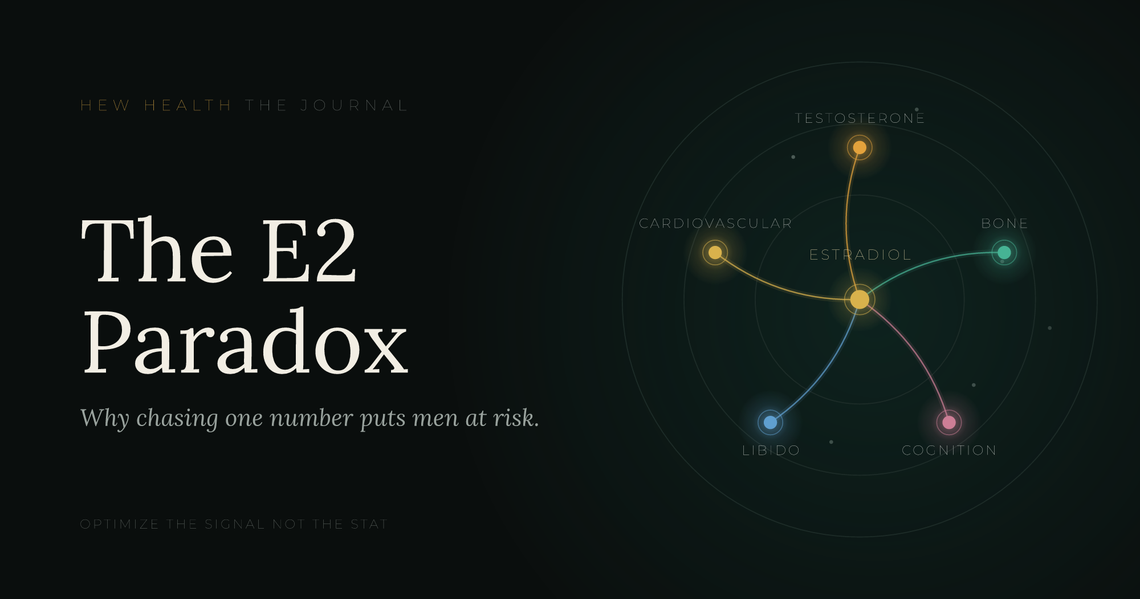
Estradiol is the hormone men on testosterone protocols worry about most, and the one they understand least. I have had patients walk in convinced their number is "too high" because a forum post told them so, and others arrive from outside clinics already on an aromatase inhibitor they never needed. Both scenarios cause problems. Let's talk about what the number actually means, what range tends to work, and why the answer is less about hitting a target and more about reading the whole picture.
Why Men Need Estradiol in the First Place
Estradiol in men is not a byproduct to be suppressed. It is converted from testosterone by the aromatase enzyme, primarily in adipose tissue, and it drives a surprising amount of male physiology: bone mineral density, lipid regulation, libido, erectile function, cognitive sharpness, and joint comfort. Men with genetic aromatase deficiency have brittle bones, poor lipid profiles, and often struggle with libido despite normal or elevated testosterone. That tells you something important. Testosterone alone, without adequate estradiol conversion, does not produce the outcomes men actually want from hormone optimization.
When men crash their estradiol with aggressive anastrozole dosing, the symptoms are often worse than the high-estradiol symptoms they were trying to fix. Aching joints, flat mood, no morning erections, trouble concentrating, and in some cases depressive symptoms that come on quickly. We see this pattern in our practice fairly often, usually in men transferring care from protocols where an aromatase inhibitor was prescribed reflexively alongside testosterone.
The Lab Range Question
Most commercial reference ranges for male estradiol sit somewhere around 10 to 40 pg/mL on the sensitive assay (LC-MS/MS), though exact cutoffs vary by lab. For men on testosterone optimization protocols, the clinically useful range tends to run a bit higher than the general male population reference, because exogenous testosterone naturally raises the substrate available for aromatization. In practice, many men feel and function best with a sensitive estradiol somewhere in the 25 to 45 pg/mL range, though I have had patients thrive at 20 and others who feel their best closer to 55.
Two things matter more than the absolute number:
- The ratio of testosterone to estradiol. A total testosterone of 900 ng/dL with an estradiol of 45 pg/mL is a very different physiologic situation than a total testosterone of 500 with the same estradiol.
- How you actually feel and function. Lab values are a guide, not a verdict.
Use the Sensitive Assay, Not the Standard One
This is a small detail that causes big problems. The standard estradiol immunoassay was designed for women, whose estradiol levels are an order of magnitude higher than men's. When used in men, it tends to cross-react with other steroids and overestimate the true value. The sensitive assay, run by liquid chromatography mass spectrometry, is the correct test for men. If your clinician is ordering the standard estradiol and then prescribing anastrozole based on the result, that is a conversation worth having. I have seen men on unnecessary medication for years because of this one lab ordering issue.
What High Estradiol Actually Looks Like
True symptomatic high estradiol in a man on testosterone optimization is usually accompanied by a cluster of findings: unusual water retention that is not explained by sodium intake or training load, nipple sensitivity or tenderness that develops over weeks, emotional lability that feels out of character, and sometimes a soft, puffy look to the face. Erectile quality can suffer, though this is often where men get confused, because low estradiol produces nearly identical sexual dysfunction.
If a man's estradiol reads 55 pg/mL on a sensitive assay, but he feels great, his libido is strong, his sleep is solid, and his body composition is improving, that number is not a problem. Treating the lab value instead of the patient is one of the most common mistakes in this field.
What Low Estradiol Looks Like
Crashed estradiol is more common than most men realize, and it tends to get blamed on other things. The classic presentation: joint aches that showed up a few weeks after starting or increasing an aromatase inhibitor, loss of morning erections despite good testosterone numbers, a flat emotional affect, dry skin, and in some cases an anxious or irritable baseline. Men will describe it as "the testosterone stopped working." The testosterone is working fine. The estradiol is too low to do its job.
Long-term, low estradiol in men accelerates bone loss and worsens cardiovascular risk markers. This is not a minor cosmetic issue. It is a meaningful health concern, which is why we are cautious with aromatase inhibitor dosing and tend to use the lowest effective dose, or none at all, in most patients.
When We Actually Use an Aromatase Inhibitor
In our practice, the majority of men on testosterone optimization do not need an aromatase inhibitor. The ones who do tend to share a few features: higher body fat percentage (more aromatase activity), a genuine symptom pattern consistent with estradiol excess, and a sensitive estradiol that has climbed well above the range where they felt their best. Even then, we typically start with very low doses, often 0.125 mg of anastrozole once or twice weekly, and we recheck labs before making further changes.
Dose and frequency of testosterone administration also matter. Men on smaller, more frequent subcutaneous injections (for example, twice weekly or every other day) tend to have more stable estradiol levels than men on large weekly intramuscular doses, which produce supraphysiologic testosterone peaks and corresponding estradiol spikes. Sometimes the answer to a high estradiol reading is not a medication at all. It is a protocol adjustment.
Body Composition Is Part of the Equation
Aromatase lives primarily in fat tissue. A man carrying 28 percent body fat will aromatize more testosterone to estradiol than the same man at 18 percent body fat on an identical dose. This is one of the reasons we talk about hormone optimization as part of a broader metabolic picture rather than a standalone prescription. Men who lose meaningful body fat during their first year on protocol often need less, sometimes much less, of any estradiol-managing medication they started on.
How We Approach Monitoring
We typically draw a full hormone panel at baseline, again at six to eight weeks after protocol initiation or any meaningful change, and then at regular intervals once a patient is stable. Beyond estradiol and total and free testosterone, we are looking at SHBG, LH, FSH, hematocrit, PSA, a comprehensive metabolic panel, and a lipid panel. Estradiol never gets interpreted in isolation. A number on a page tells me very little without the rest of the picture and a conversation about how you actually feel.
If you are on a protocol and something feels off, or if you have been told your estradiol is "too high" without a thoughtful evaluation of your symptoms and your full lab panel, it is worth a second look. If you would like to discuss your current protocol or explore whether hormone optimization is appropriate for you, contact our team to request a consultation.
The Short Version
Healthy estradiol for a man on testosterone optimization is the level at which you feel well, function well, protect your bones and cardiovascular system, and maintain libido and cognitive sharpness. For most men that falls somewhere in the 25 to 45 pg/mL range on a sensitive assay, but individual variation is real. Chase the patient, not the number. And if a clinician wants to put you on an aromatase inhibitor based on a single lab value and no symptoms, ask more questions before you fill the prescription.
Related from Hew Health